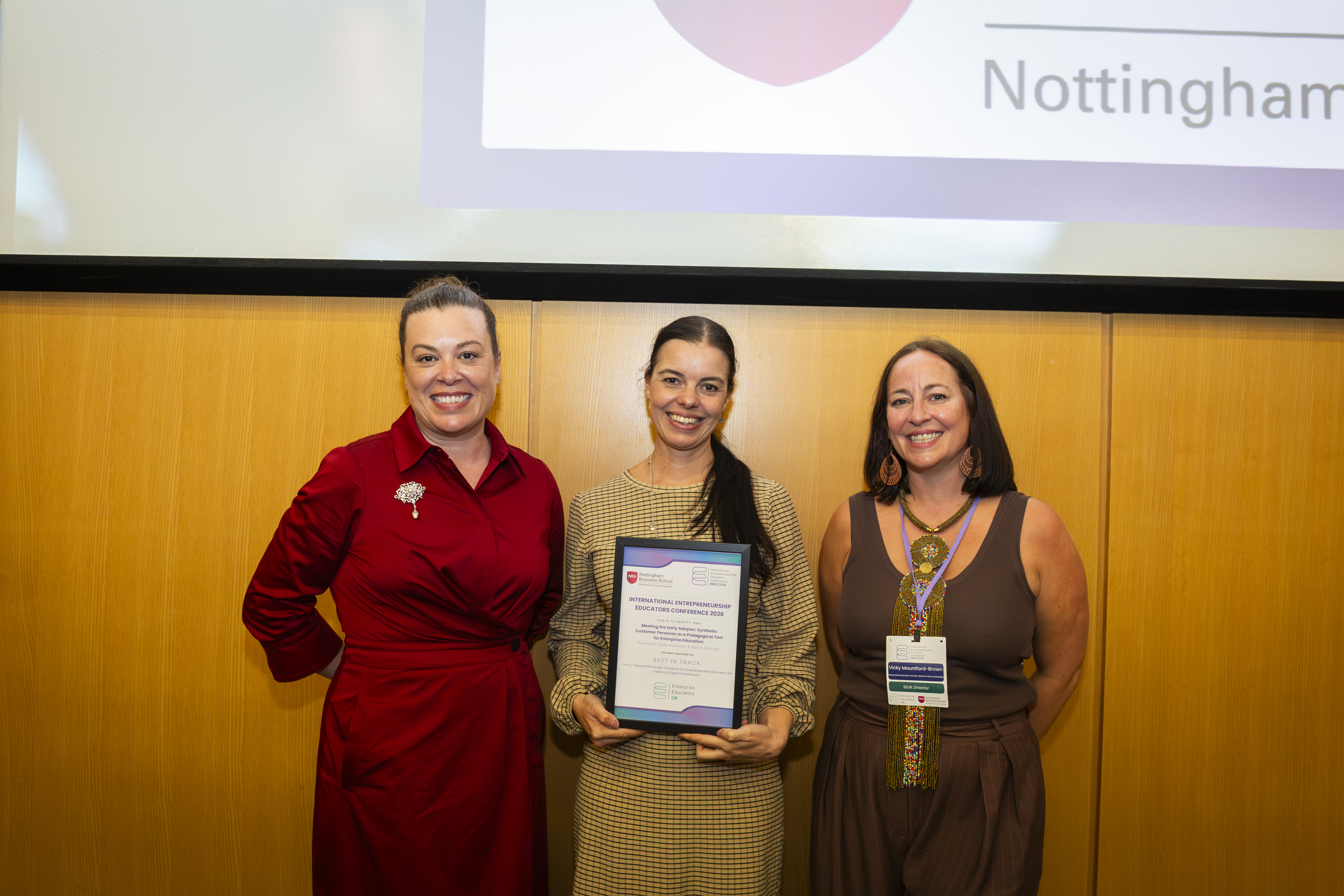
Best in Track, IEEC 2026
Synthetic Customer Persona
Describe your product and the customer you are trying to reach. Interview the persona the tool creates. Leave with a debrief and the questions to ask a real person.
How a session runs
- The user describes their product, where they are with it, and the kind of customer they have in mind.
- The tool creates a persona: a name, a role, what they care about and what they doubt.
- The user interviews them. The persona holds a position, raises objections and is not easily convinced.
- The debrief reports how far the conversation moved, what was left unresolved, and what to ask a real customer next.
- Everything can be downloaded as a PDF. Nothing is stored.
Most people take twenty minutes. Educators run it as a single session or across a module.
A rehearsal, not a verdict
The persona is fictional. A language model invents it from what the user writes and then plays it in conversation, drawing on a broad grasp of how people in a given role and sector talk about their work.
You
Everyone we have shown it to has been really positive about it.
The persona
Positive how. Did any of them change what they were doing because of it, or did they just say it sounded interesting and carry on exactly as before?
A persona declining to accept a vague answer.
That is what makes it useful for practice. The persona asks the awkward question, holds its ground, and refuses to be satisfied by a vague answer. Every debrief ends by sending the user back to real customers, better prepared than they went in.
Recognition
Best in Track, International Enterprise Educators Conference 2026
Grounded in
Rogers' Innovation-Decision Process
Time per session
About twenty minutes
Runs on
Any browser, including a phone
What a licence includes
The tool
For your participants, for twelve months, reached by a shared cohort code. Nothing to provision and no user records to manage.
Teaching materials
Session plans and exercises for running it in teaching, with guidance on leading the debrief discussion.
A briefing session
An online session for the staff delivering it: how it works, how to introduce it, what to expect from participants.
Your usage figures
A private link showing how the tool is being used across your cohorts. Numbers only, never linked to an individual.
Support
An AI support assistant at any hour, and a reply from us within one working day for anything it cannot resolve.
Evaluation instruments
Survey templates to run with your own participants, so any findings about outcomes belong to you.
Also from Synthetic Futures
Two further apps, built on the same principle: useful in the room, honest about what they know.
In development
Ferret
An evidence-based competitive analysis tool that helps businesses understand their market without blurring fact and assumption. Ferret gathers and structures competitor information, separates evidence from inference, and highlights patterns, gaps and opportunities that can inform positioning and strategy.
In development
Architect
An AI system design tool for businesses exploring automation, process improvement or new AI-enabled products and services. Architect asks a short series of adaptive questions, then recommends the right approach, whether that is automation, an AI feature, a workflow, an agent, a hybrid system or no AI at all. It produces a practical blueprint covering the system design, human checkpoints, risks and the smallest useful prototype.
Data protection
The tool holds no personal data. There is no database and there are no user accounts. Nothing a participant types is stored: the persona, the conversation and the debrief exist only in their browser.
What is counted is usage: numbers of personas, messages and debriefs against each cohort code, and the dates of use. These are integers and dates, never linked to an individual.